AI Voice Agents for Staffing Agencies: Turn Calls Into Conversations
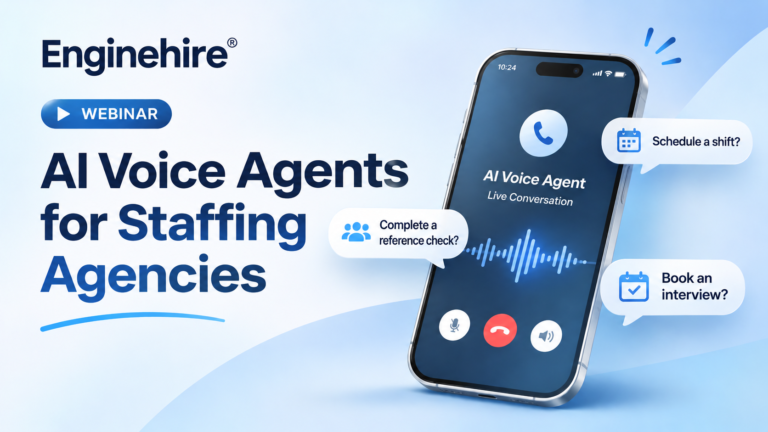
What if your agency could follow up with leads, check references, answer calls, and coordinate shifts without adding another task to your team's day? Watch Enginehire's practical walkthrough of AI voice agents and see how to put them to work inside your staffing software.
Presented by Danny Rosenthal, Director of Marketing & Partnerships at Enginehire • Recorded November 5, 2026 • Approximately 53 minutes
What are AI voice agents for staffing agencies?
AI voice agents are configurable phone assistants that hold two-way conversations with candidates, clients, employees, and references. Unlike a prerecorded reminder, they can ask questions, understand replies, collect information, arrange follow-ups, and, when configured, take actions inside a staffing platform. Enginehire connects AI voice agents with agency workflows, so the conversation can become part of the same record your team already uses.
Watch the full AI Voice webinar
See the live setup, template builder, reference checking walkthrough, and audience Q&A.
Recording date: November 5, 2026. This is a replay, not a live event.
Webinar chapters
Times are based on the November 5 recording transcript and may differ if you trim the beginning of your video.
What you'll learn in this webinar
- How AI voice agents handle inbound and outbound calls without sounding like a traditional phone tree.
- Where AI voice agents fit in recruiting, candidate intake, lead response, reference checking, and shift coordination.
- How to customize an agent's voice, instructions, tools, triggers, and handoff rules.
- How recordings, transcripts, and captured answers can help keep your staffing records organized.
- What to test before launching AI voice agents with real clients and candidates.
From notifications to actual conversations
Staffing agencies already send thousands of notifications: a candidate needs to finish onboarding, a reference has not responded, a client wants more information, or a caregiver has a question about a shift. The message gets sent, but someone still needs to have the conversation that comes next.
"The biggest thing about this is it can take notifications ... and then turn them into conversations."Danny Rosenthal, Enginehire AI Voice webinar, November 5, 2026
That distinction is the reason to consider AI voice agents. They don't simply tell someone to call the office. They can answer a question, ask for the missing detail, and move the workflow forward. Enginehire's approach is to give AI voice agents a specific job, a clear set of instructions, and the appropriate tools for that task.
In the webinar, Danny describes AI less like a magical answer machine and more like a dimmer switch. It uses the context available to it to decide how to respond. That makes clear prompts, reliable agency data, sensible guardrails, and human oversight essential. AI voice agents are there to support your staff, not invent answers or eliminate judgment.
7 practical ways staffing agencies can use AI voice agents
The most useful AI voice agents solve repeatable communication problems. Start with a specific moment when your team is waiting on a phone call, a reply, or a piece of information. For many teams, that is exactly where AI voice agents make their first real difference.
| Agency workflow | What the AI voice agent does | What your team gets |
|---|---|---|
| New lead follow-up | Calls a new client or family after a form submission, explains next steps, and offers to schedule a meeting. | Faster initial contact and a booked conversation when the calendar tool is configured. |
| Candidate intake | Asks intake or screening questions and records answers during a phone conversation. | Collected details that can be mapped into candidate profile fields. |
| Automated reference checking | Calls references, asks the questions from an agency's reference form, and records their responses. | Call status, recording, transcript, and, when enabled, answers in the original reference form. |
| Interview scheduling | Checks configured calendar availability and helps someone select a meeting time. | Less back-and-forth over appointment times. |
| Shift questions | Looks up relevant shifts, answers supported questions, and assists with shift-related requests when tools are enabled. | Fewer routine scheduling calls needing an administrator. |
| Callbacks and voicemails | Arranges a requested callback, follows retry instructions for unanswered calls, or leaves a voicemail. | A more consistent follow-up process and visible call history. |
| Service announcements | Calls selected contacts about a new service, reminder, or update as part of a communication campaign. | A two-way conversation instead of another one-way blast. |
For nanny agencies, these workflows might involve family inquiries or household staff references. For home care agencies, they may involve caregiver intake and shift questions. Healthcare staffing and general recruiting teams can adapt the same building blocks to their own processes. What matters is matching AI voice agents to work your team already does.
Example: A new lead comes in and the follow-up starts immediately
Imagine a prospective client submitting a form while your team is busy. Rather than waiting for someone to notice the new record, an agency can configure an outbound AI phone call for a particular lead status or service category. An agent calls, introduces itself, gathers context, and offers available meeting times. If the prospect wants to speak to a person, an enabled handoff can route the call to your team.
That is the value of AI voice agents connected to staffing software: the call happens within an existing workflow rather than as a disconnected conversation. You choose which types of leads get a call. Danny recommends being selective, especially when some inquiries are more time-sensitive or valuable than others.
Automated reference checks: one of the biggest opportunities
Reference checking is a natural starting point for AI voice agents because so much of the work is repetitive. Recruiters and agency owners already know the questions they want to ask. The difficult part is reaching the reference, conducting the conversation, and documenting it in the right place.
In the live demo, Enginehire's reference checking workflow shows how an agency can initiate an AI call, ask questions from its existing reference form, review the status of the outreach, and access a recording and transcript. When the relevant option is enabled, AI voice agents can place the answers into the appropriate reference form fields, so a reviewer isn't starting with a blank document.
The webinar also covers duplicate IP address and phone-number warnings in Enginehire's reference checking tools. These are signals worth reviewing, not automatic proof that a reference is invalid. An authorized team member can inspect the results and decide what to do next.
For a closer look at the feature, see Enginehire's AI reference checking software and the guide to automated reference checks with voice agents. If you only try one workflow first, reference checking is a practical place to evaluate how AI voice agents perform with your agency's real questions.
How to set up AI voice agents in Enginehire
The webinar includes a live build of an agent for new client inquiries. The exact options depend on the workflow and the tools available in your account.
- Open the voice agent settings.Go to More → Integrations → Communications → Voice Agents to explore the available connection and setup options.
- Create an AI phone call template.Go to More → Templates → AI Phone Call Templates. Choose an inbound or outbound scenario and a clear purpose for the agent.
- Give the agent instructions.Use AI Assist as a starting point, then review the persona, goals, opening line, questions, boundaries, end-call language, and voicemail message. For example, tell a lead-follow-up agent to schedule a conversation but not quote prices.
- Choose tools and triggers.Depending on the use case, enable calendar checks, meeting booking, call handoff, callback scheduling, shift lookup, or reference form questions. Set the appropriate status or manual trigger.
- Connect the data.Give the agent access to relevant profile context and map collected details to the correct fields. Check where recordings, transcripts, and completion notifications will appear.
- Test it before going live.Call the agent yourself, interrupt it, change topics, ask for a person, and see what happens when nobody answers. Confirm activation requirements with Enginehire support.
For screen-by-screen instructions, use Enginehire's AI voice workflow setup guide. It also explains how templates can be triggered by status changes.
One agent or many? Why specialized AI voice agents work better
You probably don't want a single phone assistant responsible for every conversation in your business. In the webinar, Danny recommends thinking about multiple AI voice agents with distinct jobs: one for incoming inquiries, another for outbound lead follow-up, another for references, and another for shift-related calls.
That separation makes your prompts easier to manage. Each of your AI voice agents can have a different opening message, voice, trigger, allowed actions, escalation path, and definition of success. A reference-checking agent needs to stick to the questionnaire. A lead-response agent needs to make it easy to book time with your team. A scheduling agent needs accurate shift information.
The goal is not to make calls just because you can. It's to design AI voice agents that reliably complete a narrow task, document the outcome, and know when to involve a real person.
Beyond one-to-one calls: AI voice in mass communications
Enginehire's mass communications tools already offer email, SMS, WhatsApp, and push notifications. The webinar demonstrates phone calls as an additional option, allowing agencies to select contacts and create voice-based outreach for a campaign.
Imagine a small group of clients who previously asked about a service you now offer. Instead of sending another general announcement, AI voice agents can contact those selected people with an introduction and invite them to continue the conversation. You decide who belongs in the audience and what the agent should say.
Keep outreach focused, respectful, and compliant with applicable consent and calling rules. AI voice agents are most useful when the call is relevant to the person receiving it.
Questions from the live AI voice webinar
Can different job types use different reference questions?
An attendee asked about candidates who might have worked as a nanny in one role and a private chef in another. The discussion confirmed that Enginehire supports category-based setups, while the exact experience of choosing different questionnaires for different past jobs may need a workflow review. If this matters to your agency, test that path with your real reference forms rather than assuming every scenario is automatic.
Can an AI agent avoid calling someone at 2 a.m.?
The team distinguished two things in the Q&A: a retry schedule for calls that go unanswered, and a requested callback when someone tells the agent to call later. The broader question of agency-defined outbound calling windows was not fully resolved during the webinar. Confirm your intended hours, time zones, and restrictions during setup before turning on automatic outbound calls.
Can the caller ask to speak with a real person?
Yes. The live template builder includes a call handover option. You can configure an appropriate destination when you want the agent to transfer a conversation to someone on your team. Human escalation is an important part of using AI voice agents responsibly.
Data privacy, transparency, and realistic expectations
Recruiting and care agencies handle personal information, and AI voice agents should be held to the same thoughtful standards as other agency systems. The webinar discusses Enginehire's approach to data separation and encourages agencies to set internal policies for how employees use outside AI tools.
Before launch, review access permissions, data handling requirements, appropriate call-recording notices, and any calling laws that apply to your audience and location. A voice agent should identify itself appropriately, avoid promises it cannot verify, and leave sensitive decisions to authorized staff. Ask Enginehire to confirm any specific security or compliance requirements for your organization.
AI voice agents do not eliminate the need to review outcomes. Prompts can be improved, a reference may require follow-up, and a complex caller may need a person. Start small, test edge cases, and expand when the workflow is working the way you expect.
Frequently asked questions about AI voice agents
What is the difference between an AI voice agent and a robocall?
A robocall usually plays a fixed recording. AI voice agents can listen and respond, ask follow-up questions, capture information, and use configured tools to move a task forward. The experience still depends on the quality of the instructions and setup.
Can AI voice agents screen staffing candidates?
Yes. For suitable intake workflows, AI voice agents can ask screening questions, record answers, and map collected information into candidate profiles. Your team should still review the results and make hiring decisions.
Do AI voice agents work for nanny and home care agencies?
Yes. The workflows demonstrated in the webinar apply to nanny placement, home care, healthcare staffing, and other agencies that manage candidates, clients, references, and schedules. Each agency should tailor the questions and actions to its services.
Can AI voice agents check references automatically?
Enginehire supports AI-assisted reference calls. The agent can call a reference, ask the configured questions, capture a recording and transcript, and, when enabled, enter answers into the associated form for staff review.
Can AI voice agents book interviews and appointments?
When calendar availability and booking tools are enabled, an agent can check open slots and help schedule a meeting. The webinar demonstrates how to select those capabilities in an AI phone call template.
Can AI voice agents hand calls to a real staff member?
Yes, call handover is a configurable option. Your agency chooses whether to enable it and where the call should be transferred.
Can we customize the voice and what the agent says?
Yes. Enginehire lets you select voices, write or generate prompt instructions, specify allowed actions, and add boundaries. You can set up different AI voice agents for different kinds of conversations.
Is AI voice built into staffing software, or does it require a separate system?
Enginehire provides AI phone call templates, workflow triggers, profile data mapping, and communication tools within its staffing platform. Depending on your account and use case, additional setup or activation may be needed. See the AI Voice and SMS Agents overview for more details.
Ready to put AI voice agents to work?
Start with the one conversation your agency spends too much time chasing. It could be a new inquiry, a reference check, or a shift question. Enginehire can help you map that workflow and decide where AI voice agents fit, without losing the personal service your clients expect.
Want to hear what an agent sounds like first? Try an AI voice conversation with Gene, or schedule a walkthrough to see what is possible in your own agency.
This article summarizes Enginehire's November 5, 2026 webinar. Features and available settings can vary by workflow and account. Test your configuration and confirm specific capabilities with the Enginehire team.
Don't Miss Out! RSVP for our Upcoming Webinar NOW
Additional Resources on AI Voice Agents and Recruiting
Want to learn more about how AI is changing recruiting, staffing, and workforce communication? These resources offer additional research and guidance on using AI effectively and responsibly.
SHRM: AI in HR and Recruiting
Research exploring how organizations are adopting AI to improve recruiting efficiency and HR workflows.
SHRM: The Rise of AI Interviewers
A closer look at conversational AI in candidate screening and interviewing.
NIST: AI Risk Management Framework
Practical guidance on managing AI risks, transparency, privacy, and accountability.