How AI Recruiting Tools Help Staffing Agencies Streamline Hiring
Recruitment agencies manage multiple responsibilities every day, from finding suitable candidates and reviewing resumes to coordinating interviews, following up with applicants, and maintaining client relationships. As hiring requirements increase, managing these activities manually can become time-consuming and difficult to scale.
Artificial intelligence is changing how recruitment teams approach these challenges. AI-powered technology can help recruiters process candidate information, automate repetitive tasks, identify potential matches, and organize hiring workflows more efficiently.
For modern staffing agencies, the goal is not simply to adopt new technology. It is to find practical solutions that improve recruiter productivity without losing the human element of hiring. Enginehire brings recruitment management and automation together, helping agencies build more organized and efficient recruitment processes.
What Are AI Recruiting Tools?
AI recruiting tools are software solutions that use artificial intelligence to assist with different stages of the recruitment process. They can help recruiters analyze candidate information, identify relevant skills, organize applications, automate selected tasks, and improve the way hiring activities are managed.
Depending on the platform, these tools may offer features such as resume screening, candidate matching, interview automation, recruitment workflow management, and automated communication.
For example, when an agency receives hundreds of applications for a single position, AI-assisted screening can help recruiters identify profiles that appear relevant to the job requirements. Recruiters can then review those profiles and decide which candidates should move forward.
The purpose is to reduce repetitive administrative work, improve access to relevant information, and allow recruiters to spend more time making informed hiring decisions.
Why Are AI Recruiting Tools Important for Staffing Agencies?
Staffing agencies often work with large candidate databases, multiple job openings, and several clients at the same time. Managing these responsibilities through spreadsheets, emails, and disconnected applications can create unnecessary complexity.
AI can make recruitment workflows more efficient by helping teams organize information and reduce repetitive activities.
- Faster candidate screening: Identify potentially suitable candidates based on relevant skills, experience, and job requirements.
- Improved candidate matching: Find profiles that align with specific vacancies and client expectations.
- Reduced administrative workload: Automate selected repetitive tasks and recruitment workflows.
- Better candidate management: Keep candidate records and recruitment activities organized.
- More consistent communication: Use structured workflows to manage follow-ups and candidate interactions.
- Greater recruiter productivity: Give recruiters more time to focus on interviews, candidate relationships, and client communication.
- Scalable recruitment operations: Establish more consistent processes as the agency handles additional vacancies and candidates.
These benefits depend on the quality of the recruitment data, the capabilities of the software, and how effectively the agency implements the technology.

Key Features to Look for in AI Recruiting Software
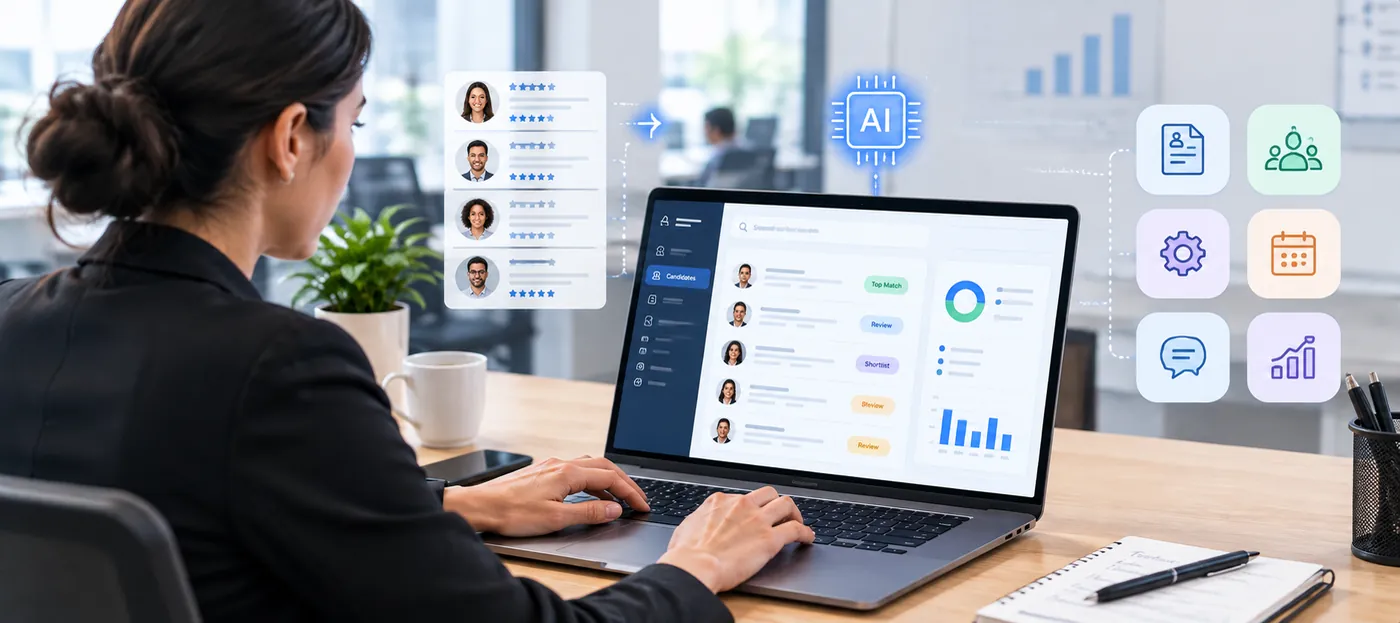
Not every recruitment platform offers the same capabilities. Before selecting a solution, agencies should identify the features that address their biggest hiring challenges.
1. AI-Powered Resume Screening
Reviewing resumes manually can consume a significant amount of recruiter time, particularly when applications arrive in large volumes.
AI-assisted resume screening can analyze candidate information and highlight profiles that appear relevant to a position. This can help recruiters prioritize applications based on job-related criteria instead of reviewing every profile in the same order.
Recruiters should still verify qualifications, experience, and other relevant details before making shortlisting decisions.
2. Intelligent Candidate Matching
Finding the right candidate requires more than matching job titles. Recruiters must consider skills, professional experience, qualifications, availability, location, and client-specific requirements.
Candidate-matching technology can help compare available profiles against these criteria and identify potential matches.
This gives recruiters a more focused starting point and can reduce the time spent searching through large candidate databases.
3. Recruitment Workflow Automation
Recruiters frequently perform repetitive activities such as updating candidate statuses, sending follow-up messages, organizing applications, and coordinating the next steps in a hiring process.
Workflow automation can reduce the manual effort required for these activities. Depending on the system, agencies can configure processes that trigger specific actions when a candidate reaches a particular recruitment stage.
Consistent workflows can also help teams avoid missed follow-ups and maintain better visibility into ongoing vacancies.
4. Interview Management and Automation
Interview coordination can become complicated when recruiters manage multiple candidates and clients simultaneously.
Recruitment software may provide interview scheduling, communication tools, or AI-assisted interviewing capabilities to make the process more manageable.
For example, automated interview workflows can help collect initial candidate information before a recruiter conducts a more detailed assessment.
The availability of these capabilities varies by platform, so agencies should evaluate whether the interview features match their hiring requirements.
5. Centralized Candidate and Client Management
Recruitment involves maintaining relationships with both candidates and employers. When information is spread across multiple tools, recruiters may struggle to access the latest details.
A centralized recruitment platform can bring candidate records, job requirements, client information, and recruitment activities into one organized environment.
This improves visibility across the hiring process and makes it easier for team members to coordinate their work.
How Enginehire Helps Recruitment Agencies Use AI
Enginehire is a recruitment management platform designed to help staffing and recruitment agencies organize their operations and manage everyday hiring activities.
For agencies exploring AI-driven recruitment, Enginehire combines recruitment workflows with automation to create a more structured approach to candidate and job management.
Streamline Recruitment Workflows
Recruitment teams need a clear process for managing candidates from initial contact through screening, interviews, and placement.
Enginehire provides a centralized environment for managing recruitment activities, helping agencies organize information and reduce reliance on disconnected tools.
A more structured workflow makes it easier for recruiters to understand candidate progress, manage job requirements, and keep track of ongoing recruitment activities.
Make Candidate Information Easier to Manage
Recruiters often work with extensive candidate databases containing resumes, contact details, qualifications, experience, and other relevant information.
Organized candidate records can make it easier to find and review profiles when new vacancies become available.
When recruitment information is maintained consistently, teams can make better use of their existing talent pools and reduce unnecessary manual searching.
Reduce Repetitive Administrative Work
Administrative responsibilities can prevent recruiters from spending enough time with candidates and clients.
Recruitment automation can help reduce repetitive work by making routine processes more consistent and easier to manage. This allows agencies to focus on improving communication, evaluating candidate suitability, and meeting client expectations.
The exact tasks that can be automated depend on the features and configuration available within the platform.
Support More Organized Recruitment Operations
As staffing agencies grow, they need processes that can accommodate additional candidates, job openings, and client requirements.
Enginehire brings recruitment management activities together, providing a foundation for more organized operations.
Rather than treating automation as a separate activity, agencies can incorporate it into their wider recruitment workflow. This helps teams maintain a clearer view of their hiring activities while working toward greater operational efficiency.
Agencies should review the platform’s current AI features and available integrations to determine which capabilities best match their specific needs.
Enginehire vs. Traditional Recruitment Processes
Traditional recruitment often depends on manual resume reviews, individual spreadsheets, email follow-ups, and separate tools for managing different activities.
These methods can work for smaller workloads, but they may become harder to maintain as recruitment demands increase.
A more organized, technology-driven process can offer several advantages:
| Traditional Recruitment | AI-Assisted Recruitment |
|---|---|
| Manual review of large numbers of resumes | Technology-assisted candidate screening |
| Time-consuming candidate searches | More targeted candidate discovery |
| Repetitive administrative activities | Automated workflows where available |
| Candidate information spread across tools | Centralized recruitment records |
| Manual tracking of recruitment progress | Structured workflow visibility |
| Significant time spent on routine tasks | More time available for candidate and client relationships |
AI does not eliminate every recruitment challenge. Its effectiveness depends on accurate information, suitable software, clearly defined processes, and appropriate human oversight.
How to Choose the Right AI Recruiting Tool
Selecting recruitment software requires a clear understanding of your agency’s operational needs. A platform with many features may not be the best choice if it does not solve your team’s most pressing problems.
Consider the following factors before making a decision.
- Understand your recruitment workflow: Identify where your team spends the most time, whether that involves sourcing, screening, interview coordination, follow-ups, or candidate management.
- Evaluate the available features: Check whether the platform offers the capabilities your agency needs and whether those features are included in your selected plan.
- Consider integration requirements: Determine whether the software works with your existing recruitment systems and business processes.
- Review usability: A system should be practical for recruiters to use daily without creating unnecessary complexity.
- Assess data security: Recruitment systems handle personal candidate information, so access controls, privacy practices, and responsible data management are important considerations.
- Measure performance: Track indicators such as time to shortlist, recruiter administrative time, interview conversion rates, and candidate response rates to evaluate whether the software delivers meaningful improvements.
- Keep human oversight: AI-generated recommendations should be reviewed carefully. Recruiters must remain responsible for fair, job-related, and well-informed hiring decisions.
Common Mistakes to Avoid When Adopting AI in Recruitment
Even useful recruitment technology can produce disappointing results when introduced without a clear plan.
One common mistake is expecting AI to solve every recruitment problem immediately. Agencies should begin with specific operational challenges and introduce automation where it offers measurable value.
Another mistake is relying on incomplete or outdated candidate data. Poor-quality information can reduce the usefulness of screening and matching processes.
Recruiters should also avoid treating automated recommendations as final hiring decisions. Human review helps identify missing context, evaluate relevant qualifications, and reduce the risk of unfair outcomes.
Finally, agencies should measure results instead of assuming that adopting AI automatically improves performance. Regular evaluation helps identify which workflows are effective and where further improvements are needed.
The Future of AI Recruiting Tools
Artificial intelligence is becoming an increasingly important part of recruitment technology. Improvements in data analysis, workflow automation, and conversational AI are creating new opportunities for staffing agencies to manage hiring activities more efficiently.
Future recruitment systems are likely to place greater emphasis on personalized candidate communication, faster information processing, and more connected recruitment workflows.
However, successful recruitment will continue to depend on human judgment and relationships. Candidates expect clear communication and fair consideration, while clients need recruiters who understand their business requirements.
The most effective approach combines technology with recruiter expertise. AI can help reduce repetitive work and organize information, while recruiters focus on evaluating suitability, building trust, and making informed decisions.
Why Consider Enginehire for Your Recruitment Agency?
Enginehire offers recruitment management capabilities that can help staffing and recruitment agencies organize candidates, jobs, and everyday workflows.
For agencies looking to modernize their operations, a centralized recruitment platform can provide a more structured foundation for managing hiring activities and reducing administrative complexity.
When evaluating Enginehire, consider how its available features align with your agency’s workflow, recruitment volume, integration requirements, and long-term growth plans.
Choosing the right technology is not only about introducing AI. It is about building a recruitment process that is organized, practical, and capable of adapting as business needs change.
Discover How Enginehire Can Transform Your Recruitment Process
See How Agencies Use Enginehire to Transform Their Recruitment Process

Sarah M.
When I first spoke with Enginehire I thought the price was a little steep and almost did not move forward. Ever since then the price is worth every penny. If I ever need anything updated, they respond almost immediately with a solution. They are continuously working to keep the system updated and always adding new features
View Enginehire Reviews

Debra Fortosis
I have used two other management platforms and I can tell you that Enginehire is the best. Want a one-stop shop? You can match people to jobs, build resumes directly from their profiles, and so much more in seconds. Enginehire has saved me money by saving me time.
View Enginehire Reviews

James McCrossen
Enginehire has been a game-changer for my agency. One of the biggest standouts is their tech support. Using Enginehire has genuinely helped me become more efficient and streamlined our operations. Highly recommend it to any agency owner looking to level up.
View Enginehire Reviews

Amelia D’Urso
I should have done this months ago. I waited out of fear and concern that automation wouldn’t be the right fit for such a personalized service. I was so wrong and I’m kicking my past self for waiting! Any agency that is on the fence or considering Enginehire should just take the plunge. It is worth every penny!
View Enginehire Reviews

Lydia B – Owner of
The Enginehire Team have been excellent to work with and provide phenomenal customer service . Their knowledge of the industry and individual customization is unparalleled and their platform has revolutionized the way that my team does business.
View Enginehire Reviews

Ruka Curate
We have used so many platforms. From iCims to Bullhorn, to trying to create ones ourselves with Zoho, Asana, Monday.com, Trello, and Airtable. They just did not work for our industry. Enginhire has created a logical system that is simple to use with lots of amazing features. I am so glad we found them.
View Enginehire Reviews

George Johnson
The software is brilliant, it is the only one we could find in our 4 years of looking that would do exactly what we wanted. It has honestly taken a huge amount of admin of our hands. It is is almost 100% customisable.

Deniz Hanson
The Enginehire team was absolutely wonderful to work with; professional, dedicated, and supportive. I cannot recommend Enginehire enough if you’re looking for a way to streamline your processes and work with a patient and understanding team.
View Enginehire Reviews
Trusted By Hundreds of Agencies as the Smarter AI Recruitment Tools